Prop 8 rally on Cedar Springs
WATCH: Prop 8 rally on Cedar Springs
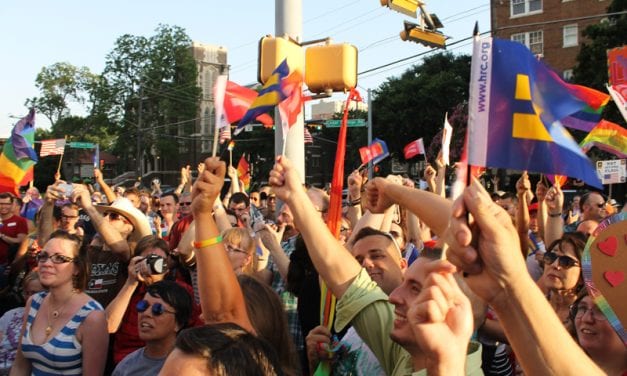
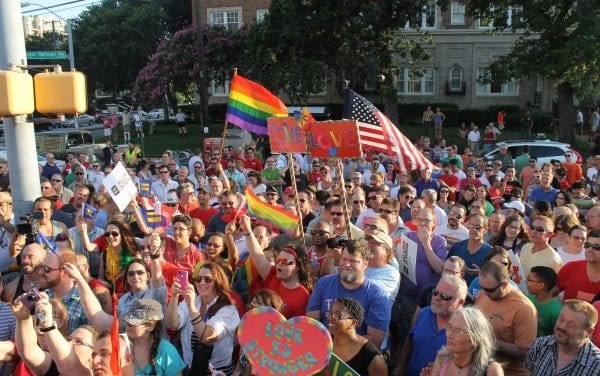
About 100 people braved the sweltering heat and gathered around the Legacy of Love Monument on Wednesday evening to celebrate the Prop 8 decision.
VICTORY: Federal judge strikes down Prop 8
Judge also issues a temporary stay, meaning same-sex marriages won’t be performed in California right away
Lisa Keen | Keen News Service
In an historic, potent, and eloquent decision, U.S. District Court Judge Vaughn Walker ruled Wednesday, Aug. 4 that California’s constitutional amendment banning same-sex marriage violates the federal constitution’s guarantees to equal protection and due process of law. The opinion represents the first major victory for legal challenges against state bans on same-sex marriage in any federal court.
“Race and gender restrictions shaped marriage during eras of race and gender inequality,” wrote Walker, in his 136-page opinion, “but such restrictions were never part of the historical core of the institution of marriage. Today, gender is not relevant to the state in determining spouses’ obligations to each other and to their dependents. Relative gender composition aside, same-sex couples are situated identically to opposite-sex couples in terms of their ability to perform the rights and obligations of marriage under California law. Gender no longer forms an essential part of marriage; marriage under law is a union of equals.”
“[T]he exclusion [of same-sex couples from marriage] exists as an artifact of a time when the genders were seen as having distinct roles in society and in marriage,” wrote Walker. “That time has passed.”
A few minutes after issuing the decision, Walker also approved a temporary stay of its impact and gave attorneys challenging Proposition 8 until Friday, Aug. 6 to submit their reasons for opposing the continuation of the stay until a federal appeals court can weigh in on the case.
The decision in Perry v. Schwarzenegger, which has been much anticipated by both sides of the same-sex marriage debate, says supporters of the November 2008 ballot measure failed to establish any rational reason for prohibiting same-sex couples from having marriage licenses.
Judge Walker, an appointee of Republican President George H.W. Bush, said Proposition 8, because it burdens the fundamental right to marry, must pass the most difficult judicial standard — known as strict scrutiny. But he said the law failed to pass even the simplest standard — that of identifying at least one rational reason for treating a group of people differently.
“Even if California had an interest in preferring opposite-sex parents to same-sex parents,” wrote Walker, “… Proposition 8 is not rationally related to that interest, because Proposition 8 does not affect who can or should become a parent under California law.”
Shannon Minter, legal director for the National Center for Lesbian Rights, called the decision “a tour de force — a grand slam on every count.”
“The court held that Prop 8 violates the fundamental right to marry and discriminates on the basis of both sex and sexual orientation in violation of the equal protection clause,” he said.
“The court,” said Minter, “held that laws that discriminate based on sexual orientation must be subject to the highest level of constitutional review, but that Prop 8 would fail even the lowest test, because it is based solely on moral disapproval of gay people.
“This is without a doubt a game-changing ruling,” said Minter. “Today’s decision is the most comprehensive, detailed decision addressing the constitutional rights of same-sex couples to affirmative recognition and support ever to be issued by a federal court.”
Longtime lesbian legal activist and law professor Nan Hunter was somewhat more reserved in her reaction.
“It’s a thorough analysis and a comprehensive review of the factual and quasi-factual bases for each side’s arguments in the marriage debates,” said Hunter.
“Is it a watershed, either legally or culturally?” asked Hunter on her blog hunterforjustice.com. “Too soon to know.”
Two other lawsuits have challenged state bans on same-sex marriage in federal courts, but both were dismissed and were not appealed.
Two federal cases challenging part of the federal Defense of Marriage Act (DOMA) won critical district court victories just last month in Boston and both are expected to be appealed to the 1st Circuit U.S. Court of Appeals. Perry and these two cases are expected to eventually reach the U.S. Supreme Court and are on track to arrive at approximately the same time.
There is little doubt that Judge Walker was keenly aware of how important his decision would be, and he seemed to make a concerted effort, during trial, to allow supporters of Proposition 8 to enter whatever evidence they could to defend the law. The State of California declined to defend the law, so the group that campaigned for the ballot initiative — Yes on 8 — hired a legal team to do so. But that legal team relied primarily on “legal conclusions and cross-examinations of some of plaintiffs’ witnesses,” noted Walker, “eschewing all but a rather limited factual presentation.”
“At trial,” said Walker, Yes on 8 attorneys, led by conservative Charles Cooper, “presented only one witness, David Blankenhorn, to address the government interest in marriage.” Walker said Blankenhorn’s testimony “provided no credible evidence to support any of the claimed adverse effects” of allowing same-sex couples to obtain marriage licenses.
Walker said, “California has no interest in differentiating between same-sex and opposite-sex unions” and that “domestic partnerships lack the social meaning associated with marriage” and do not provide gays and lesbians with “a status equivalent to marriage …”
The absence of Proposition 8 does not require any religious group to recognize marriage for same-sex couples, but the existence of “Proposition 8 places the force of law behind stigmas against gays and lesbians,” Walker wrote.
“Proposition 8 singles out gays and lesbians and legitimates their unequal treatment,” he wrote. It “perpetuates the stereotype that gays and lesbians are incapable of forming long-term loving relationships and that gays and lesbians are not good parents.”
Walker agreed that gays and lesbians have “been the victims of a long history of discrimination” and that “no credible evidence supports a finding that an individual may, through conscious decision, therapeutic intervention or any other method, change his or her sexual orientation.” Those findings are important to establishing a requirement that Proposition 8 be able to withstand a strict judicial scrutiny.
Walker ruled that Proposition 8 violates both the due process and equal protection clauses of the U.S. Constitution’s 14th amendment. The 14th amendment states, among other things, that “No State shall make or enforce any law which shall abridge the privileges or immunities of citizens of the United States; nor shall any State deprive any person of life, liberty, or property, without due process of law; nor deny to any person within its jurisdiction the equal protection of the laws.”
When governmental law burdens a fundamental right, such as marriage, said Walker, the law must withstand strict scrutiny. And Proposition 8, he said, could not withstand even the simplest judicial review — rational basis.
“The right to marry has been historically and remains the right to choose a spouse and, with mutual consent, join together and form a household,” wrote Walker. While an “initiative measure adopted by the voters deserves great respect,” said Walker, the voters’ determinations “must find at least some support in evidence.”
“Conjecture, speculation and fears are not enough,” wrote Walker. “Still less will the moral disapprobation of a group or class of citizens suffice, no matter how large the majority that shares that view.” The evidence presented at trial, he said, “demonstrated beyond serious reckoning that Proposition 8 finds support only in such disapproval.”
The U.S. Supreme Court, in Romer v. Evans, ruled in 1996 that animus against any particular group could not be used to justify a law that disadvantages that group.
Yes on 8 attorneys, apparently anticipating a loss at the district court level, filed a motion with Judge Walker on Tuesday night, asking that, if the court rules against them, to issue a stay of the impact of his decision pending their expected appeal to the 9th Circuit U.S. Court of Appeals. Attorneys for the two gay couples challenging Proposition 8 — Kristin Perry and Sandra Stier and Paul Katami and Jeff Jzarrillo — submitted a letter, prior to release of the decision, saying the request was premature.
Judge Walker, in approving a stay of the impact of his decision, gave plaintiffs’ attorneys until Friday to file their formal response to the request for a stay. He did not schedule an in-court proceeding to hear arguments concerning the stay but simply said that the temporary stay would remain in effect until he rules on the request.
Meanwhile, pre-planned rallies to celebrate — or protest — Wednesday’s ruling were scheduled to take place in major cities across the country Wednesday evening, even before the decision was released. Rallies were planned in a number of major cities around the country following release of the decision — including Atlanta, Boston, Dallas, West Hollywood and San Diego.
The Perry decision comes less than two months after Walker heard closing arguments in the case, but six months after the close of testimony in a three-week-long trial in the U.S. District Court of Northern California in San Francisco.
The legal team challenging Proposition 8 was led by two of the country’s most prominent and respected attorneys — conservative Ted Olson and liberal David Boies. The challenge was organized and funded by the newly formed Americans Foundation for Equal Rights, headed by Democratic activist Chad Griffin.
Griffin organized the challenge shortly after California voters, in November 2008, approved Proposition 8, amending the state constitution to bar recognition of same-sex marriage. The California Supreme Court had ruled, only six months earlier, that the state constitution required same-sex couples be treated the same as heterosexual couples in state marriage licensing. More than 18,000 same-sex couples obtained marriage licenses before Proposition 8 became law and those marriages are considered valid. Opponents of the new amendment challenged it in state court but the California Supreme Court ruled that the measure was valid. It also ruled that the 18,000 marriage licenses would also remain valid.
The case drew widespread national attention, not only because of the high profile legal team and the irony of such a conservative icon as Olson leading the case, but also because national gay legal and political groups were initially hostile to the effort. The groups said they felt a lawsuit taking the issue of same-sex marriage to the U.S. Supreme Court was too risky, given the likelihood the case would reach the high court at a time when the court is considered to increasingly conservative.
Lambda Legal Defense and Education Fund, the National Center for Lesbian Rights, and the ACLU were also denied the right to serve as a party to the case — a development that caused considerable chagrin within the LGBT community. But the groups did contribute to the litigation, providing advice on expert witnesses that delivered a wealth of ammunition against the ballot measure. All three groups filed briefs in support of the plaintiffs. And all three, of course, applauded the result of Wednesday’s decision.
Jenny Pizer, head of Lambda’s National Marriage Project, said Judge Walker’s decision was “historic,” and applauded his “methodical assessment of the evidence presented at trial.” She predicted the decision would have “immense positive implications as the case advances, and in the national struggle for full LGBT equality.”
“The right-wing excuses for denying same-sex couples the right to marry have had an all-too-familiar and ugly ring, echoing the defamatory stereotypes used against us in past decades to deny jobs and other basic rights. Today’s decision,” said Pizer, “examines and explodes each of these lies about us, yielding yet another important legal ruling justly concluding that constitutional guarantees of liberty and equality must require equal treatment under a state’s marriage laws.”
“Judge Walker’s ruling,” said NCLR Executive Director Kate Kendell, “is complete vindication for the most bedrock principles this nation is built on: a majority cannot strip a minority of fundamental rights, we do not permit bare prejudice or even discomfort to provide the basis for sweeping and damaging discrimination, and protecting loving families and couples is the humane and just thing to do. Prop 8 was a major stain on the kind of nation we strive to be, good riddance.”
James Esseks, director of the ACLU’s Lesbian, Gay, Bisexual and Transgender Project, called the decision “a huge victory for LGBT people of America.”
“For the first time, a federal court has conducted a trial and found that there is absolutely no reason to deny same-sex couples the fairness and dignity of marriage,” said Esseks, in a statement. “At the same time, we know that this is not the end.”
The end, of course, could be an eventual U.S. Supreme Court decision — something that is not necessarily guaranteed. Thousands of cases are petitioned to the high court every year, but the court hears only a tiny fraction. The likelihood the court would take an appeal on this case — once the 9th Circuit appeals court has weighed in ± is probably enhanced by the high=profile, widespread fights over same-sex marriage bans nationally and by the involvement of such a high-profile and well-respected legal team as Olson and Boies. But it may also be diminished, depending on whatever the 9th Circuit says. Ultimately, at least four justices must ask to hear the case before the Supreme Court will take it for review.
Meanwhile, the expected confirmation of Solicitor General Elena Kagan to the Supreme Court is not likely to change the conservative lean of the current court, given that she replaces one of the court’s most liberal justices, John Paul Stevens.
© 2010 Keen News Service
Below is the full text of Walker’s ruling:
Lambda Legal’s Ken Upton says today’s Prop 8 ruling will have little immediate practical impact
We spoke Wednesday morning with Ken Upton, a senior staff attorney with Lambda Legal who’s based in Dallas, about the potential legal implications of this afternoon’s expected ruling in the Prop 8 case. Specifically, we asked Upton what the ruling could mean to folks in Texas, and why we should care.
Upton noted that even if U.S. District Judge Vaughn Walker strikes down Prop 8, it’s likely that the decision will be put on hold pending appeal, meaning no same-sex marriages will be performed in California.
“In the short run, it’s not going to do anything as a practical matter because it will be stayed,” Upton said of today’s decision. “Nobody’s going to get married in California, and the decision won’t be the final decision, because it’s going to get appealed at least once. As a practical matter, it won’t really do anything, but it will start the ball rolling on a path that could eventually do something.”
Upton said he is optimistic Walker will strike down Prop 8.
“I read the transcripts, and I heard the arguments, and I read the briefs,” Upton said. “The law is strong in our favor and the evidence was I thought very persuasive in our favor, so it won’t surprise me if he rules for us.”
But Upton added that the key to today’s ruling is not whether Judge Walker upholds or strikes down Prop 8, but the manner in which he does so.
“The result won’t be the final one anyway,” he said. “At this point, he’s just firing the first salvo if you will. What will really be interesting is how far he goes. What will he say about the constitution and how it protects gay people? What level of scrutiny will he give it? Will he talk about marriage itself or will he talk about discrimination against gay people? The immediate effect of it will be more one for lawyers to dissect than it will have any practical effect. It’s going to be years before we know the ultimate result.”
Despite minimal practical impacts, Upton acknowledged that a victory today will give the LGBT community a psychological boost.
“It feels good to see courts do what they’re constitutionally required to do, and that is be a check on government and the political arms of government,” he said. “One colleague suggested that everybody have a bottle of tequila in their office, and once we win, every time the other side calls him [Walker] an activist judge, take a shot, and see how long it takes to get drunk.”
BREAKING: Prop 8 ruling coming Wednesday; Day of Decision rally planned for Cedar Springs
According to the U.S. District Court website for the Northern District of California, Judge Vaughn Walker will issue his decision on Wednesday, Aug. 4 in the Proposition 8 trial:
On August 4, 2010, the court will issue its written order containing findings of fact and conclusions of law following the court trial held in January and June of this year. The order will be e-filed in the court’s Electronic Case Filing system, and will be immediately available thereafter through ECF and PACER. There will be no court proceeding associated with the publication of the order.
UPDATE: From the American Foundation for Equal Rights, which brought the lawsuit:
The federal court announced today that it will release its decision in the American Foundation for Equal Right’s landmark case, Perry v. Schwarzenegger, on Wednesday. Text “EQUAL” to 69866 to get a text message with the official decision on your mobile phone the moment the court releases its decision, or sign-up for an email alert at equalrightsfoundation.org. Join AFER on its Web site to watch a live press conference with our plaintiffs and co-counsels Ted Olson and David Boies following the release of the decision. As we receive news about the details of the release, AFER will update our Facebook and Twitter profiles, along with our Web site.
UPDATE NO. 2: According to Equality Across Texas, there will be a rally — win or lose — at 6 p.m. Wednesday at the Legacy of Love Monument, at Oak Lawn Avenue and Cedar Springs Road:
Bring signs, flags and LOUD voices!
The Dallas action is being led by C.D. Kirven with GetEqual Now. To help plan, promote, or sponsor the Dallas action, please email cdkirven@aol.com
UPDATE No. 3: The ruling is expected to be issued between 1 p.m. and 3 p.m. Pacific time, which is 3 p.m. and 5 p.m. Dallas time.
UPDATE No. 4: The anti-marriage equality folks have filed a motion seeking a stay if Judge Walker strikes down Prop 8. Such a stay would presumably mean that same-sex marriages could not be performed pending the appeal of Walker’s decision. Our sources indicate that it’s likely Walker will grant this stay. If he strikes down Prop 8 and doesn’t grant the stay, the anti-gay marriage side would immediately request a stay from the appeals court, which also would likely be granted. In other words, it’s unlikely that marriages will be performed Wednesday or anytime in the near future.
Tennessee DMV refuses to give woman a driver’s license with new last name after her legal same-sex marriage in D.C.
The full faith and credit clause of the U.S. Constitution says that each state has to respect the “public acts, records and judicial proceedings” of the other states in this country. Traditionally, that has been understood to include legally contracted marriages. But, of course, Congress in 1996 passed the Defense of Marriage Act — or DOMA — which says the federal government will not recognize legal same-sex marriages and which allows individual states to refuse to recognize legal same-sex marriages from other jurisdictions.
So, we get situations like this, documented by WUSA9.com in in Washington, D.C.:
Gay and Lesbian Advocates and Defenders (GLAD) has challenged that portion of DOMA that prohibits federal recognition of legal same-sex marriages, and a decision is pending in a Massachusetts court in that case. And of course, a decision is also pending in a California federal court in the lawsuit challenging the constitutionality of the California constitutional amendment banning same-sex marriage.
There are other arguments for giving federal recognition to same-sex marriages and for requiring all states to recognize a legally contracted same-sex marriage from any state. Some arguments are based on the Constitution’s equal protection clause; some involve separation of church and state. And of course, there’s the basic idea of fairness — you know, that whole “liberty and justice for all” thing?
Who knows how it’s all going to wind up. But I am pretty sure it is going to take a U.S. Supreme Court ruling to settle it one way or another. And even that might not be the final word. One thing I do know, until it is settled, we’re going to keep hearing stories like Traci Turpin’s. And that is not fair.
LGBT leaders praise Ted Olson's performance during closing arguments in federal Prop 8 trial
Plaintiffs’ attorney says marriage ban causes ‘grave and irreparable’ harm; other side warns ‘no one can know’ consequences of overturning it
By Lisa Keen | Keen News Service
SAN FRANCISCO — There were so many people trying to get in to watch the final day of the landmark trial challenging California’s same-sex marriage ban, the court staff had to set up an additional overflow room for observers.
Those dozen or so members of the public who managed to snare seats in Courtroom 6 on the 17th floor of San Francisco’s federal courthouse building had to stand in line starting at 5:45 Wednesday morning to get them.
But gays in California are used to standing in line. They stood in line exactly two years ago – June 16, 2008 — to be among the first same-sex couples to obtain marriage licenses in the state. Now, they were watching closing arguments in Perry v. Schwarzenegger, a historic case challenging the November 2008 initiative that took away the right for gay couples to obtain marriage licenses in California.
California commission fines Mormon church $5K for failing to report Prop 8 contributions

- Fred Karger

The California Fair Political Practices Commission has ordered the Church of Jesus Christ of Latter-day Saints to pay a $5,538 fine after the church failed to properly report its contributions — about $37,000 — to the 2008 campaign to pass Proposition 8, the ballot initiative that successfully amended the state’s Constitution to ban same-sex marriage.
The vote happened in November 2008, about five months after the California State Supreme Court ruled that a ban on gay marriage violated the California Constitution.
The fine came in response to a complaint filed by Fred Karger, a California gay man who fought against Prop 8 and who earlier this year launched his own campaign for president.
According to the Los Angeles Times, a statement on the website on the Salt Lake City-based church’s website said it “unintentionally failed to file daily reports detailing approximately $37,000 in non-monetary contributions. The amount of contributions not reported represented the cost of staff time spent by church employees on activities to help the Yes on 8 committee during the final two weeks of the election.”
CBS News reports: “While the Fair Political Practices Commission could have assessed a $5,000 fine for each violation, it reportedly opted for a streamlined process that resulted in a deal with the church for the $5,539 fine.”
Prop 8 judge is gay

- Chief U.S. District Judge Vaughn Walker

San Francisco Chronicle columnists Phillip Matier and Andrew Ross on Sunday “outed” Chief U.S. District Judge Vaughn Walker as a gay man. Walker, by the way, is the jurist who will, in the next few weeks, be issuing a ruling on whether California’s Proposition 8 banning same-sex marriage in that state violates the U.S. Constitution.
In their article, Matier and Ross said Walker’s orientation is “the biggest open secret” in the Prop 8 lawsuit, and that gay lawyers and politicians in San Francisco don’t think the judge’s personal orientation will have any effect on his ruling. (Hmmm. Big surprise there. Surely Matier and Ross didn’t expect the gays to say the fact that the judge is gay gives the plaintiffs in the case an advantage, did they?)
But if the plaintiffs — the folks challenging Prop 8 — win, you can be DAMN SURE the defendants are going to make a big deal out of the fact that Walker is gay. And what if the defendants will in Walker’s court? What will the gay folks say about a gay judge that ruled against them? Apparently, Walker already has some experience with that: As Matier and Ross point out, he had to fight the reputation of being anti-gay when he was trying to get to be a judge because back in the 1980s, he successfully represented the U.S. Olympic Committee in a lawsuit to keep the San Francisco Gay Games from using the name “Gay Olympics.”
The columnists also point out that the case was assigned to Walker; he didn’t “seek it out,” and that he was appointed to the bench by President George H.W. Bush, someone not seen as particularly gay-friendly.
So, what do you think? Is it an advantage for gay marriage supporters that the judge hearing the case is gay? Or is it a hidden pitfall that will work against the gay marriage cause in the long run?
Prop 8 trial rests
Plaintiff’s attorney David Boies finished destroying the second defense witness of Wednesday.
David Blankenhorn, the president and founder of the Institute for American Values, testified that procreation is central to marriage. Boies used some of Blankenhorn’s own writings that were favorable to same-sex marriage to discredit his testimony. He has called same-sex marriage a “victory for the worthy ideas of tolerance and inclusion,” and an “expansion of the American idea.”
Boies asked Blankenhorn about married couples that do not have sex. Blankenhorn said that he had never met one.
He claimed that more same-sex marriages would lead to more one-parent households. He did not explain why, unless he doesn’t count both gay or lesbian parents.
He said, “the rights of gays and lesbians should take second place to the needs of an existing social institution.” So an idea (traditional marriage) is more important than people and their rights.
The judge adjourned the trial. He gave both sides until Feb. 26 to file additional documents. He’ll schedule closing arguments at that time, and the trial is on hiatus until then.