Dallas’ Cd Kirven played role in Supreme Court rally controversy

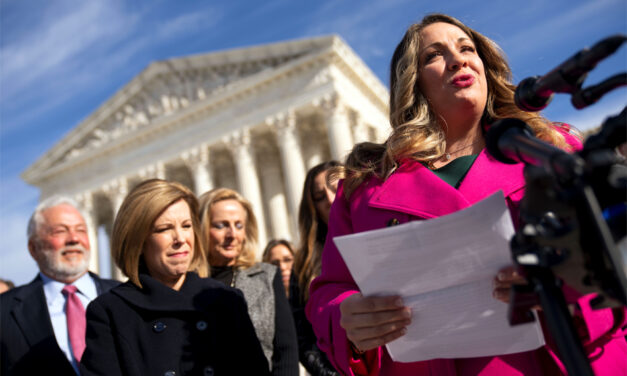
Cd Kirven at Supreme Court - High Res

Cd Kirven at Supreme Court (Photo courtesy Cd Kirven)

Dallas activist Cd Kirven says she played a role in the much-publicized controversy involving a transgender pride flag at a rally outside the U.S. Supreme Court last month.

Kirven said that after an HRC staffer told transgender activists to remove a transgender pride flag from behind the podium,  she picked it up and tried to make sure it was in every camera shot.

On March 26, about 8,000 people rallied for marriage equality outside the Supreme Court while justices heard oral arguments in a case challenging the Defense of Marriage Act. The rally was organized by United for Marriage, a coalition of 180 groups, but Kirven, who was a scheduled speaker, said HRC was in control of the stage and the event. Kirven is a national board member for GetEQUAL.

Kirven said she had to submit her speech and got it back about 15 minutes before she was about to speak with sentences blacked out and words changed. She said she stumbled through parts of it because it wasn’t her words.

“They said I was too aggressive and dark,” Kirven said.

—  David Taffet

Congressman Marc Veasey issues statement on Prop 8, DOMA cases

Official Photo_Rep Marc Veasey

Rep. Marc Veasey

Freshman Congressman Marc Veasey, D-Fort Worth, reminded his North Texas constituents Tuesday that he is committed to fighting for full equality for LGBT citizens.

Veasey released the following statement today following the opening arguments in the Proposition 8 case before the U.S. Supreme Court.

“As the Supreme Court considers the constitutionality of Proposition 8 and the Defense of Marriage Act, I would like to reaffirm my commitment to the LGBT community,” the statement reads.

“It is my hope that the justices of the nation’s highest court rule that committed same-sex couples have civil and constitutional rights. The struggle for equality has taken us from Stonewall to the Supreme Court.

“As decades of progress have changed attitudes and opened hearts, I will continue to fight for members of the LGBT community until they have full equality under the law.”

—  Anna Waugh

Equality Texas among groups to file joint brief in marriage equality cases

EqualityTexas

Equality Texas has joined more than two-dozen statewide organizations in filing a joint amicus brief in the two marriage equality cases currently before the U.S. Supreme Court.

The “Red State Brief” is a brief supported by the Utah Pride Center, Campaign for Southern Equality, Equality federation and 25 statewide advocacy groups. It calls for the court to uphold appellate court rulings that found the Defense of Marriage Act and Proposition 8 unconstitutional. It explains the history of anti-gay legislation in many states that degrade LGBT citizens and deny them freedoms.

“This brief calls for an end to the systemic denigration of lesbian, gay, bisexual and transgender Americans,” Equality Texas Executive Director Chuck Smith said. “The U.S. Supreme Court is being asked to consider whether all Americans are entitled to equal treatment under the law regardless of their sexual orientation or gender identity/expression. The Court must answer this question with a resounding, ‘Yes, ALL Americans must be treated equally.’”

Read the brief here.

—  Anna Waugh

Alvarado cafe owner likely will have to pay $5K for implying customer was gay

The Texas Supreme Court has refused to hear the appeal of a cafe owner in Alvarado, a town south of Fort Worth, who was ordered to pay a customer $5,000 for making comments that implied he was gay.

The attorney for the customer said the case was about his client being humiliated repeatedly and not a gay issue. However, the comment from the cafe owner implied he was gay, and he could only have been humiliated if being gay were something to be ashamed of.

A state district judge and appeals court both ruled in the customer’s favor. By refusing to hear the case, the Supreme Court allows the lower court’s ruling to stand. The cafe owner now must pay her customer $5,000.

So now can sue when people call us straight?

—  David Taffet

LGBT groups praise Supreme Court’s health care decision — except for Log Cabin Republicans

The Supreme Court’s decision Thursday upholding the Affordable Care Act will affect access to healthcare across the LGBT community. People will not lose their health insurance because of HIV status or other pre-existing conditions, and transgender people cannot be denied coverage.

In its decision, the Supreme Court ruled that the penalty for not buying insurance under the “individual mandate” is a tax and is therefore constitutional.

While the ACA makes insurance coverage more widely available to the LGBT community, the ruling allows states like Texas to refuse federal money to expand Medicaid to cover more people unable to afford private health insurance.

Insurance should be more accessible once statewide insurance exchanges are created, but Texas has done little to begin creating those exchanges, banking on the ACA being declared unconstitutional. State exchanges will not be allowed to discriminate based on sexual orientation, gender identity or sex.

Dallas’ AIDS Interfaith Network called the decision a “major step forward in the fight against HIV/AIDS.

In a press release, AIN wrote:

By upholding the Affordable Care Act, ensuring more individuals can obtain health insurance coverage, the Court removed a major roadblock to ending AIDS in America.

People living with HIV will have access to the reliable health coverage they need to seek and maintain continuous care, without unnecessary worrying about interrupts in care because of inadequate coverage or inability to pay.

National LGBT organizations, with the exception of Log Cabin Republicans, praised the decision.

—  David Taffet

“Defining Marriage: A Debate!” at U of H tomorrow

Dr. Jennifer Roback Morse

Dr. Jennifer Roback Morse

One day we will get to the point where an University inviting guests to debate marriage equality will be greeted with the same scorn that an on-campus debate on women’s suffrage or whether or not African-Americans are 3/5 of a person would engender, but that day is not today. Just in time for the expected U.S. Court of Appeals for the Ninth Circuit ruling on Prop. 8  tomorrow, Feb. 7, the Federalist Society and Outlaw at the University of Houston present “Defining Marriage: A Debate!” at noon in the Bates Law Building room 109.

Dr. Jennifer Roback Morse, founder of the Ruth Institute, a project of the National Organization for Marriage, will be on hand to defend the continued prohibition against marriage equality. Mitchell Katine, who served as local counsel in Lawrence v. Texas (the Supreme Court case declaring Texas’ law against “homosexual conduct” unconstitutional) will defend marriage as a civil right, constitutionally guaranteed by equal protection under the law.

As a bonus the first 70 attendees to arrive will receive a free Chick-Fil-A sandwich and waffle fries, because we like our civil rights debated with a side of irony.

After the jump get a sneak peak at the kind of keen logical arguments to be expected from Dr. Morse:

—  admin

U.S. Supreme Court: Religious groups exempt from employment discrimination laws

U.S. Supreme Court Building

The U.S. Supreme Court on Wednesday, Jan. 11, issued a ruling exempting religious groups from nondiscrimination in hiring laws when it comes to ministers and those who teach religious subjects, according to this report in The New York Times.

“The interest of society in the enforcement of employment discrimination statutes is undoubtedly important,” Chief Justice John G. Roberts Jr. wrote. “But so, too, is the interest of religious groups in choosing who will preach their beliefs, teach their faith and carry out their mission.”

The ruling came in the case Hosanna-Tabor Church v. Equal Employment Opportunity Commission, in which former teacher Cheryl Perich claimed she was fired from her job at a Lutheran School in Redford, Mich., because she pursued a discrimination complaint based on a disability (Perich suffers from narcolepsy).

School officials said Perich — who was called a teacher that had completed religious training and who taught mostly secular classes but did also teach a religion class and attend chapel with her class — was fired because she violated church doctrine by pursuing litigation rather than trying to resolve the dispute within the church.

The Rev. Barry Lynn, executive director of Americans United for Separation of Church and State, said he fears the court’s decision this week will make it harder to combat the “social evil” of “blatant discrimination,” and suggested the ruling could prevent pastors who are sexually harassed from filing suit against their harassers.

But Bishop William E. Lori, chair of the United States Conference of Catholic Bishops‘ ad hoc committee for religious liberty, told the Times the ruling was “a great day for the First Amendment.” The Catholic Church has in some cases shut down programs to avoid having to abide by state and federal nondiscrimination laws protecting LGBT people, including the decision in December by bishops in Illinois to close most of their church’s adoption and foster care services rather than allow same-sex couples to adopt or foster children, as per new state requirements for agencies that receive state funds. Catholic Church officials in Washington, D.C., and Massachussets had made similar decisions previously.

Although this particular case had nothing at all to do with issues of sexual orientation or gender identity, it’s not hard to imagine how easily it can be used against the LGBT community. As Florida Courier columnist Charles W. Cherry II writes: “Can predominately white churches and religious schools now fire black ‘ministers’ (who are also teachers) because of their race and be legally protected from a race discrimination lawsuit? Sounds like it to me — and the court ruled unanimously. Could this case be interpreted to mean that black churches can now legally fire effeminate (or openly gay) ‘ministers’ of music without worrying about a lawsuit in places where sexual orientation is legally protected?”

—  admin

Remembering John Lawrence, the man behind Lawrence v. Texas

Lawrence

John Lawrence and Tyrone Gardner

Metro Weekly reports that one-time Houstonian John Geddes Lawrence, the “Lawrence” in Lawrence v. Texas, passed away last month at the age of 68:

“In the facts underlying the Supreme Court case, Lawrence v. Texas, Lawrence and Tyron Garner were arrested under Texas’s Homosexual Conduct Law after police entered Lawrence’s home on Sept. 17, 1998, and saw them “engaging in a sexual act.” The couple challenged the law as unconstitutional”

I was 22 and living in Dallas in 2003 when the Supreme Court issued its opinion in Lawrence declaring Texas’ law against “homosexual conduct” unconstitutional. A group of over 100 people gathered in the parking lot of the Resource Center of Dallas as Dennis Coleman, then with Lambda Legal, read excerpts of the decision. I remember the exuberant electricity in the air, the crowd bubbling with joy and the relief of centuries of official oppression finally coming to an end. Similar get-togethers took place across the state, as an entire community breathing a collective sigh of relief.

That relief has turn to frustration over the years. Although the Supreme Court decision rendered Penal Code Section 21.06 unconstitutional, the law remains on the books, and efforts to remove it have met with significant resistance. During a hearing this spring on finally removing the unconstitutional law, Rep. Jose Aliseda, R – Pleasanton, lamented that repeal of the law would entail removing portions of the Health Code requiring that HIV education efforts include information that “homosexual conduct is not an acceptable lifestyle and is a criminal offense under Section 21.06, Penal Code.”

Before Lawrence several attempts were made to remove the law against “homosexual conduct.” The Texas legislature voted to remove it from the penal code as part of a complete rewrite of the code in 1971, but the measure was vetoed by Gov. Preston Smith. In 1973 the Legislature again undertook a rewrite of the code, keeping “homosexual conduct” a crime but making it a class C misdemeanor. In 1981 a U.S. District Court ruled in Baker v. Wade that the law was unconstitutional, but as that case was winding its way through an unusually torturous appeals process the Supreme Court ruled in Bowers v. Hardwick that a similar law in Georgia was constitutional, making the questions in Baker moot. Similarly, in the 90′s there was hope that Texas v. Morales might finally prevail in defeating the “homosexual conduct” prohibition, but the Texas Supreme Court decided that since, in their opinion, the law was rarely enforced, there was no reason for them to rule in the matter.

Lawrence’s legacy lives on in a scholarship named after him and Garner administered by the Houston GLBT Community Center. The scholarship “recognizes outstanding leadership shown by gay, lesbian, bisexual, and transgender Texas high school seniors and college
students by contributing to the cost of their continuing education. Selection is based upon character and need.” Tim Brookover, president of the community center, expressed sorrow at Lawrence’s passing “John was a hero, the community owes a great debt of gratitude to John and Tyrone for taking the case all the way to the Supreme Court,” said Brookover. “They could have easily allowed it to slip away, but they decided to stay and fight and that makes them heroes and role models.”

The application deadline for the John Lawrence/Tyrone Gardner Scholarship is March 2, 2012.

—  admin

High court denies appeal from gay couple seeking accurate birth certificate for adopted child

Ken Upton

Ken Upton

In a setback for same-sex parenting rights, the nation’s high court today refused to hear a challenge of a Louisiana policy barring gay couples from obtaining accurate birth certificates for their adopted children. Lambda Legal reports:

The U.S. Supreme Court today denied Lambda Legal’s petition for a writ of certiorari in the case of a same-sex couple seeking an accurate birth certificate for their Louisiana-born son whom they adopted in New York. The Louisiana state registrar has refused to recognize the adoption and issue a birth certificate listing both fathers as the boy’s parents.

“By denying this writ, the Supreme Court is leaving untouched a dangerous Fifth Circuit Court of Appeals ruling that carves out an exception to the Full Faith and Credit Clause of the U.S. Constitution and to the uniformly recognized respect for judgments that states have come to rely upon,” said Kenneth D. Upton, Supervising Senior Staff Attorney in Lambda Legal’s South Central Regional Office in Dallas. “This decision leaves adopted children and their parents vulnerable in their interactions with officials from other states.”

“More particularly, this decision leaves a child without an accurate birth certificate listing both his parents,” Upton added. “This issue now moves into the legislative arena. We need to push for a change in Louisiana state policy in order to stabilize and standardize respect for parent-child relationships for all adoptive children.”

Lambda Legal represents Oren Adar and Mickey Smith in their case against Louisiana State Registrar Darlene Smith. Adar and Smith are a gay couple who adopted their Louisiana-born son in 2006 in New York, where a judge issued an adoption decree. When the couple attempted to get a new birth certificate for their child, in part so Smith could add his son to his health insurance, the registrar’s office told him that Louisiana does not recognize adoption by unmarried parents and would not issue it with both adopted parents’ names.

Upton, who’s based in Dallas, has said he’s also interested in challenging Texas’ statute, which says the adoptive parents listed on an amended birth certificate must be a man and a woman. State Rep. Rafael Anchia, D-Dallas, introduced a bill this year that would have allowed same-sex couples to have both their names on adoptive birth certificates, but the bill didn’t make it out of committee.

“This case has direct implications for TX, which does not provide accurate birth certificates for adopted children with same-sex parents,” Equality Texas wrote this morning on Facebook in response to the Supreme Court’s denial of the couple’s appeal. “This must be corrected! … If you have legally adopted children who cannot get an accurate amended birth certificate in TX, please contact Info@EqualityTexas.org.”

—  John Wright

Judge to rule this week in Nikki Araguz case

Nikki Araguz

Transgender widow vows appeal if she loses case

JUAN A. LOZANO  |  Associated Press

WHARTON, Texas — The transgender widow of a Texas firefighter will likely learn next week whether his family’s request to nullify their marriage and strip her of any death benefits will be granted, a judge said Friday.

State District Judge Randy Clapp made the announcement after hearing arguments in a lawsuit filed by the family of firefighter Thomas Araguz III, who was killed while battling a blaze last year. The suit argues that his widow shouldn’t get any benefits because she was born a man and Texas doesn’t recognize same-sex marriage.

The widow, Nikki Araguz, said she had done everything medically and legally possible to show that she is female and was legally married under Texas law. She believes that she’s entitled to widow’s benefits.

“I believe the judge is going to rule in my favor,” Araguz said after the court hearing.

The lawsuit seeks control over death benefits and assets totaling more than $600,000, which the firefighter’s family wants to go to his two sons from a previous marriage. Voiding the marriage would prevent Nikki Araguz from receiving any insurance or death benefits or property the couple had together.

Thomas Araguz died while fighting a fire at an egg farm near Wharton, about 60 miles southwest of Houston, in July 2010. He was 30.

His mother, Simona Longoria, filed a lawsuit asking that her son’s marriage be voided. She and her family have said he learned of his wife’s gender history just prior to his death, and after he found out, he moved out of their home and planned to end the marriage.

But Nikki Araguz, 35, has insisted that her husband was aware she was born a man and that he fully supported her through the surgical process to become a woman. She underwent surgery two months after they were married in 2008.

Longoria’s attorney, Chad Ellis, argued that Texas law — specifically a 1999 appeals court ruling that stated chromosomes, not genitals, determine gender — supports his client’s efforts to void the marriage.

The ruling upheld a lower court’s decision that threw out a wrongful death lawsuit filed by a San Antonio woman, Christie Lee Cavazos Littleton, after her husband’s death. The court said that although Littleton had undergone a sex-change operation, she was actually a man, based on her original birth certificate, and therefore her marriage and wrongful death claim were invalid.

Ellis presented medical and school records that he said showed Nikki Araguz was born without female reproductive organs and that she presented herself as a male while growing up and going to school. He also said her birth certificate at the time of her marriage indicated she was a man.

“By law, two males cannot be married in this state,” Ellis told the judge.

Nikki Araguz, who was born in California, did not change her birth certificate to reflect she had become a female until after her husband’s death, said Edward Burwell, one of the attorneys for Thomas Araguz’s ex-wife, Heather Delgado, the mother of his two children.

But one of Nikki Araguz’s attorneys, Darrell Steidley, said that when his client got her marriage license, she presented the necessary legal documents to show she was a female. He also noted changes made in 2009 to the Texas Family Code that allowed people to present numerous alternatives to a birth certificate as the proof of identity needed to get a marriage license. That was an example, he argued, of the state trying to move away from the 1999 appeals court ruling.

The changes in 2009 allowed transgendered people to use proof of their sex change to get a marriage license. The Texas Legislature is currently considering a bill that would prohibit county and district clerks from using a court order recognizing a sex change as documentation to get married.

After the hearing, the firefighter’s family and attorneys for his ex-wife criticized plans by Nikki Araguz to star in a reality television dating show and implied she was only interested in money and fame that the case would bring her.

“That is absurd,” Nikki Araguz said in response. “I’m after my civil equality and the rights that I deserve as the wife of a fallen firefighter.”

If the judge rules against the firefighter’s family in their motion for a summary judgment, the case would then proceed to trial. Araguz said if the judge rules against her, she would appeal, all the way to the U.S. Supreme Court if necessary.

—  John Wright