SMU sexual assault shines light on male victims who break their silence

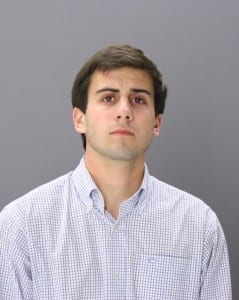
John David Mahaffey

The arrest of a male SMU student last week for allegedly sexually assaulting a male acquaintance sheds light on the small percentage of male victims who actually report such assaults.

John David Mahaffey, 19, was arrested after the victim, also a student, told SMU police he was forced to perform oral sex on Mahaffey in a parking garage at 3050 SMU Blvd., which is the address of Sigma Phi Epsilon fraternity where Mahaffey was a member.

Mahaffey has been banned from campus and suspended from the fraternity.

Jana Barker, executive director at Dallas Area Rape Crisis Center, said national statistics show that 3 percent of men will experience or commit rape in their lifetime. She said among male rape victims, only about 7 percent will report the sexual assault. Barker said gay men are often targets of sexual assault because of their sexual orientation.

No statistics could be found on the number of gay men who are raped and the number of male rapes on college campuses.

Many men never come forward to report the encounters because of the stigma of being raped and being a man and often because they feel they are targeted because they have gay tendencies, Barker said. Some male victims question their sexual orientation afterward.

She said male victims also believe only gay men commit rape, but that is untrue.

“Rape is about power and control,” she said. “It’s not sex. It’s violence.”

Police later recorded a phone call between the victim and Mahaffey during which Mahaffey told the victim he should say the encounters were consensual.

Mahaffey is part of prominent SMU legacy. His great-great grandfather was a member of SMU’s founding committee and one of its first professors, NBC 5 reports. His grandmother, father and two aunts are alumni.

SMU spokesman Kent Best said the university isn’t commenting beyond a written statement because the investigation is ongoing.

“On Tuesday, Sept. 25, 2012, SMU Police arrested an SMU student for an alleged sexual assault that occurred Sept. 23, 2012, on the SMU campus,” the statement reads. “SMU Police will present the findings of its investigation to the Dallas County District Attorney’s Office. The student is temporarily banned from campus pending further investigation.”

The U.S. Justice Department extended the definition of rape in January to include male rape. The definition had only stated that men who forcibly have sex with women was rape, excluding men who rape men and forced oral sex.

—  Anna Waugh

Spectrum again seeks LGBT senator at SMU

Members of gay student group speak out after registrar cuts off talks over diversity seat proposal

SEEKING REPRESENTATION  |  Spectrum members, from left, Jessica Barner, Eric Douglas, Danielle Palomo, Breanna Diaz, Jakob Schwarz and Kristen Baker-Fletcher outside an SMU Student Senate meeting this week. (David Taffet/Dallas Voice)

SEEKING REPRESENTATION  | Spectrum members, from left, Jessica Barner, Eric Douglas, Danielle Palomo, Breanna Diaz, Jakob Schwarz and Kristen Baker-Fletcher outside an SMU Student Senate meeting this week. (David Taffet/Dallas Voice)

DAVID TAFFET  |  Staff Writer

UNIVERSITY PARK — Progress toward an LGBT Student Senate seat at Southern Methodist University came to a halt last week when the school registrar cut off talks with Karen Click, director of the Women’s Center for Gender and Pride Initiatives.

“I need to put this project on hold for a while, as I don’t have the resources now,” Joe Papari, SMU’s director of enrollment services for student systems and technology, wrote in an email to Click.

Papari couldn’t be reached for comment.

On Tuesday, Feb. 14, members of the LGBTQA student group Spectrum addressed the Student Senate to ask for help in restarting the talks about a Senate seat.

“Show how progressive our campus can be,” Spectrum President Harvey Luna urged the Senate.

Tom Elliott, who now works for the Travis County Democratic Party in Austin,  first brought the idea of an LGBT seat to the Senate in 2009 when he was a senior.

Elliot said when he served on the Senate’s Diversity Committee, it dealt with finding more resources for minorities and better ways to recruit new students from those communities.

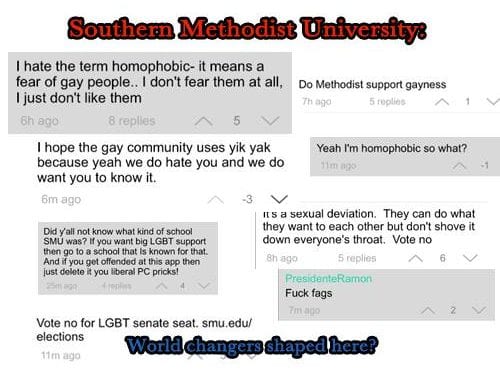
He thought that with the negative publicity SMU gets from the Princeton Review rating of the school as one of the 20 most homophobic campuses in the U.S., an LGBT senator would send a positive signal to potential incoming students that while the student body remains conservative and seems lacking in diversity, everyone is actually welcome at SMU.

The Princeton ranking is based on student surveys. In many ways, SMU doesn’t fit the profile of other schools on the list. SMU is the only school on the list with inclusive nondiscrimination policies, domestic partner benefits for employees, sanctioned LGBT student groups and openly gay faculty and staff who are embraced by the administration.

In December 2009, the Student Senate voted against adding the LGBT diversity seat. The vote was 19-19, but a three-fourths majority was needed to pass the resolution that would have then gone to the entire student body for a vote.

But the perception of the school remains one where gays and lesbians are not welcome, according to members of Spectrum who believe that a diversity seat would help change that.

Last year, Spectrum again urged the Senate to add the seat but they again voted it down citing the difficulty in identifying LGBT students and uncertainty about how many students the senator would represent.

“They were concerned with numbers,” said Spectrum member Eric Douglas. “They threw out 150 as a number.”

He laughed at the idea that on a campus with 11,000 students, fewer than 150 would be LGBT.

Senate Secretary Martha Pool said that there’s concern about double representation and questioned all diversity seats.

“Special interests are supposed to have liaisons,” she said. “There’s supposed to be a senator [assigned to] every student group. That way, everyone is fairly represented.”

However, no one from Spectrum who attended the Senate meeting on Tuesday had ever met a senator assigned to their group.

Spectrum member Kristen Baker-Fletcher objected to the idea that a senator who isn’t a member of the LGBT community could represent those students well.

She mocked the idea, characterizing it as, “We have efficient people who can speak for you.”

Spectrum’s activist chair Breanna Diaz said that a diversity senator would represent all LGBT students, not just the few who belong to one of the school’s several gay groups. She said an LGBT representative would bring issues to the Senate that aren’t currently being addressed, including health, mental health and safety.

Diaz said a major concern from last year seems to be resolved. In talks with the registrar, an optional slot could be added to the online student information profiles. Students could indicate their sexual orientation or gender identity on a confidential page. Those who self-identified as members of the LGBT community could vote for the diversity senator but wouldn’t have to belong to a campus LGBT organization.

Several senators asked whether a resolution to the registrar would make a difference.

Spectrum member Jakob Schwarz said, “The only leg the registrar’s office can stand on is that students don’t want it. A resolution by the Student Senate would be an indication of students do want.”

Click wasn’t sure that registration on the campus database was necessarily the answer.

“Is this the one stumbling block?” Click asked, adding that she doesn’t know the answer.

Click said the question of who would vote for the LGBT seat is complicated since a lot of allies attend Spectrum, many LGBT students don’t belong to any of the campus groups, and reaching out to them all is difficult because of the transience of an undergraduate population.

“There’s no easy fix,” she said.

This article appeared in the Dallas Voice print edition February 17, 2012.

—  Michael Stephens

SMU sends 18 to Midwest LGBT conference

Iowa State University is hosting the 2012 Midwest Bisexual, Lesbian, Gay Transgender Ally College Conference Feb. 10-12. One student from Texas Women’s University, 17 from Southern Methodist University’s LGBT group Spectrum and an SMU professor are attending, according to the Daily Campus. Spectrum Co-President Harvey Luna put the group together after attending last year’s conference, according to the SMU newspaper.

Karen Click at SMU Women’s Center for Gender and Pride Initiatives called it a national conference for student leaders. She said this is the second year SMU has participated.

“They come back inspired to create change on campus,” she said.

Registration for the event is $80 per person and the group chartered a bus from Dallas.

“The SMU Student Senate paid for them to go,” Click said.

The MBLGTACC conference began in 1991 and takes place annually in the upper Midwest. The goal is to learn new strategies to face problems LGBT students face on campus daily.

Two weeks ago, Youth First Texas hosted a conference of North Texas gay-straight alliances.

—  David Taffet

Chard nominated to education board

Openly gay SMU dean faces Senate confirmation hearing to earn spot in Obama administration

DAVID TAFFET  |  Staff Writer
taffet@dallasvoice.com

Chard.David

David Chard

Openly gay Southern Methodist University Dean David Chard has been nominated to the National Board for Education Sciences by President Barack Obama.

If approved by the Senate, Chard will be one of 15 voting members appointed by the president. The board is the research arm of the Department of Education.

Chard is unable to comment about the position until after the confirmation hearing.

He was among three people named to the board by Obama on Oct. 19. The others are Larry V. Hedges and Hirokazu Yoshikawa.

Hedges is professor of statistics and a faculty fellow of the Institute for Policy Research at Northwestern University.  Yoshikawa is professor of education and the academic dean at the Harvard Graduate School of Education.

Chard has been dean of SMU’s Annette Caldwell Simmons School of Education and Human Development since 2007. He served as director of graduate studies for the department of special education at the University of Oregon from 2003 to 2005, and as associate dean of the College of Education at the University of Oregon from 2005 to 2007.

Since arriving at SMU, Chard has become active in the LGBT community. Working with Resource Center Dallas, he created a counseling internship program that is a partnership between his school and the Oak Lawn agency.

He also spearheaded efforts to get SMU to become a Black Tie Dinner sponsor.

The Education Department position is advisory. The members consult with the director to approve priorities and guide the work of the institute.

This article appeared in the Dallas Voice print edition October 21, 2011.

—  Kevin Thomas

‘Hold Your Peace’ Dallas premiere tonight at Angelika

Free movie? Yes, please

When Southern Methodist University alum Wade McDonald set out to make his debut feature film, the one thing he didn’t want to do was make a “typical” gay film: No naked boys as the selling point, no ridiculous gay-angst drama, no coming-out story. McDonald loves romantic comedies and wanted to make his own — just with men.

His plan worked. The result, Hold Your Peace, seems to have resonated with audiences.

Read the entire article here.

DEETS: Angelika Film Center, 5321 E. Mockingbird Lane. Sept. 20 at 7 p.m. Free (passes at Buli or Skivvies). HoldYourPeaceMovie.com.

—  Rich Lopez

Far from Brokeback

With ‘Hold Your Peace,’ SMU grad Wade McDonald adds his name to a budding local community of queer filmmakers

SO HAPPY TOGETHER | Soon-to-be-marrieds Max (Tyler Brockington, above left) and Forrest (Blair Dickens) trigger mixed feelings from Max’s ex in the new film from local filmmaker Wade McDonald, on set right, opposite page.

RICH LOPEZ  | Staff Writer
lopez@dallasvoice.com

…………………….

HOLD YOUR PEACE
Angelika Film Center, 5321 E. Mockingbird Lane. Sept. 20 at 7 p.m. Free (passes at Buli or Skivvies). HoldYourPeaceMovie.com.

……………………..

When Southern Methodist University alum Wade McDonald set out to make his debut feature film, the one thing he didn’t want to do was make a “typical” gay film: No naked boys as the selling point, no ridiculous gay-angst drama, no coming-out story. McDonald loves romantic comedies and wanted to make his own — just with men.

His plan worked. The result, Hold Your Peace, seems to have resonated with audiences.

“We finished in April 2011 and started applying to film festivals right away,” McDonald says. “We premiered in Philadelphia and it snowballed form there to San Diego and even a non-gay film fest in Rhode Island. We got a distributor before the film even premiered! It was crazy.”

Dallas audiences get their first chance to screen Hold Your Peace at the Angelika Film Center Mockingbird Station on Tuesday — just in time for Pride.

“It hadn’t shown here yet, but a friend of our audio editor, Terry Thompkins, was kind enough to pay for a screening,” he says. “I’m so excited it’ll show at the Angelika because I love it there.”

McDonald describes Peace as a meditation on relationships where shenanigans ensue after Aiden is asked to be the best man at his ex Max’s commitment ceremony. Only Aiden isn’t too keen on going alone, much less going at all.

What McDonald strived for was not a “gay movie” per se, but a film where characters happen to be gay. Anyone gay or straight can identify with the situation of unexpressed love and torch-bearing. At the same time, it was important to create a fun and easy watch that fairly portrayed queer men.

“It’s a very human and very honest film. This is a portrayal of normalcy,” he says. “I’ve had straight people tell me they didn’t think they would like this film. It plays a bit safer and I think more people can relate to it.”

McDonald funded Peace mostly on his own, making it on a $200,000 budget. By Hollywood standards, that’s nothing, but it’s high for indies. But he knew he had to make the production high quality. As a cinematographer by day, he had both the know-how and the equipment to shoot a film that looked polished. But he holds the entire cast and crew responsible for putting out a quality product. Don’t call him the film’s auteur — this was completely a team effort.

McDonald is intent on making his mark in queer cinema. Hollywood can take care of itself, he says, but he feels at home in Dallas. A burgeoning community of local gay filmmakers has left him with the sense there’s something special going on around here. He joins Israel Luna, Shawn Ewert, Robert Camina, Yen Tan and Mehul Shah as current or recent Dallasites forming a budding cinema community, turning Dallas into a Mecca of queer film. Hey, it could happen.

“I think it’s something that’s unique to Dallas,” he says. “We are starting something here and if we begin producing enough content here then we can create an industry. Something that can let people quit their day jobs to work on something they love.”

McDonald has no intention of moving to Los Angeles or New York for his movie career. He grew up here, went to SMU for school and he now lives with his partner in Plano. McDonald is the local boy done good, but who hasn’t moved away. He prefers to keep it that way.

“I’m proof positive you can do it in Dallas,” he says. “I could move to L.A., but my personality doesn’t mesh there and that’s fine. It’s inexpensive to shoot here, we have a great support system and I’d love to continue making films right here.”

For now, McDonald is gearing up for his initial Dallas screening. He showed it to cast and crew already, but now the general public gets to see his finished product. For any filmmaker, putting his work out there is nerve-racking, but McDonald and team already see the film taking on a life of its own.

“It’s your baby in a way and you don’t wanna be told you have an ugly baby,” he says. “I’m very proud of what we accomplished with Hold Your Peace and everyone worked their butt off. We’re not setting out to make great literature, just a film that’s fun to watch. You’re just supposed to enjoy it.”

This article appeared in the Dallas Voice print edition September 16, 2011.

—  Michael Stephens

Local briefs

Miller to speak at GLFD event

Former Dallas Mayor Laura Miller will speak at the Gay and Lesbian Fund for Dallas membership kickoff event at 6 p.m. on Tuesday, Sept. 13, in the Fifth Floor Owners’ Lounge at The House at Victory Park, 2200 Victory Park Ave.

GLFD raises money to support local organizations outside the LGBT community to raise the visibility of and awareness of philanthropy in the LGBT community. Among previous GLFD beneficiaries are The Women’s Museum, Parkland Hospital, the Latino Cultural Center, the Dallas Symphony and Southern Methodist University.

Until now, money was raised through donations and events. Now, GLFD is soliciting memberships. A basic annual membership fee is $50. For $200, the “Advocate” level also includes two invitations to an annual member appreciation event. The $500 “Philanthropic Partner” level also includes optional website recognition.

Anyone who would like to attend should email Keith Nix at knix@keithnix.com.

UUCOC offers grief workshop

The Unitarian Universalist Church of Oak Cliff, 3839 West Kiest Blvd., will begin a grief workshop series and a speakers forum next week.The workshop series is for those coping with loss, whether from the death of a loved one, the end of a relationship or termination from a job.

Hosted by the Rev. Mark Walz, the workshops will be lead by the Rev. Xolani Kecala, chaplain and affiliated minister of UUCOC.

Interested parties should call 214-337-2429 to reserve a space. The workshops take place Sept. 15 and Oct. 13.

The Second Wednesday Speaker’s Forum kicks off on Sept. 14 with Garrett Mize, Texas Freedom Network’s youth advocacy coordinator.

Mize’s efforts focus on engaging young people to become leaders in advocating for evidence-based, comprehensive sex education.

Light refreshments and discussion begin at 6:30 p.m. Mize’s presentation begins at 7 p.m. followed by a service from 8 p.m. to8:30 p.m. focusing on the evening’s topic.

Austin Pride to help wildfire victims

Austin Pride events scheduled for Saturday will continue as planned, despite wildfires that have ravaged surrounding counties this week. But in response to the fire, Pride organizers said they are organizing a clothing and non-perishable food drive with GoingUpDay.org to help those displaced by the fires, which have destroyed more than 1,300 homes, many in Bastrop County, just east of Austin.

Austin Pride takes place Saturday, Sept. 10 in downtown Austin at Riverside Drive and South 1st Street at 8 a.m. For more information, visit AustinPride.org.

This article appeared in the Dallas Voice print edition September 9, 2011.

—  Michael Stephens

SMU gets 4 stars for gay-friendliness

The group Campus Pride has given Southern Methodist University 4 out of 5 stars in its LGBT-Friendly Campus Climate Index. This stands in stark contrast to the Princeton Review’s ratings, which ranked SMU among the 20 most gay-unfriendly campuses in the country.

Karen Click, director of the SMU Women’s Center for Gender and Pride Initiatives, said of the Campus Pride rating, “What we’re doing, we get graded very high on.”

Click said Campus Pride is helpful with suggestions, and a faculty and staff LGBT group began as a result of a comment from last year’s survey.

She said that with housing, for example, other campuses offer to match a gay person with an LGBT-accepting person. SMU doesn’t offer that service yet.

Princeton Review bases its score entirely on student surveys. Campus Pride looks at school policies and activities. But in student life, the group gave SMU 5 stars. Below is the breakdown of SMU’s rating from Campus Pride:

—  David Taffet

SMU makes Princeton Review’s ‘homophobic’ list again

DISCRIMINATION? | Joe Hoselton, aka Jenna Skyy, director of graduate admissions at Meadows School, sits in his office at SMU with his Miss Texas FFI crown on his desk. (David Taffet/Dallas Voice)

Despite the Dallas university’s broad range of programs and outreach to the LGBT community, students still rank it worse than even Baylor when it comes to ‘LGBT friendly’

DAVID TAFFET | Staff Writer
taffet@dallasvoice.com

Southern Methodist University in Dallas is the 12th most LGBT-unfriendly school in the country, according to the annual ranking compiled and issued by the Princeton Review.

But LGBT faculty, staff and alumni and straight allies say that Princeton Review doesn’t look at the whole picture and their school simply doesn’t belong in the same category as other schools whose policies are clearly discriminatory.

And rather than acknowledge strides the school has made in recent years, the list moved SMU to No. 12 this year, up from the 16th
position the Dallas university occupied last year.

The conservative Baptist school Baylor University in Waco, in the No. 11 spot last year, didn’t make the list at all this time around.

Dallas has the distinction of being the only city with two schools on the list — SMU and, at No. 9, the University of Dallas. And Texas is the only state with three schools on the list. In addition to the two in Dallas, Texas A&M comes in at No. 10.

SMU, which has been on the list for several years, is the only school in the group whose non-discrimination policies specifically include protections for the LGBT community.

Karen Click, director of the Women’s Center at SMU that includes LGBT programs, said she was hoping her school was moving off the list. She was disappointed that it moved up instead.

“As the staff member charged with improving the climate, it’s frustrating,” she said.

Click said that Campus Pride also surveys schools about the climate on campus and provides useful input. A new LGBT faculty and staff group was organized at the school this year as a result of recommendations from the group.

In June, a new LGBT alumni organization met for the first time. Openly gay Dean David Chard hosted the first reception for the group in the Gay and Lesbian Fund for Dallas reception lounge in the new Simmons School of Education building.

In contrast, Baylor alumnus Patti Fink said, several years ago when a group of alumni tried to organize an LGBT alumni group, rather than welcome their donations, Baylor sent them a cease and desist order.

Chard said he was probably the only openly gay dean among any of the schools that made the bottom 20.

Fink joked that she didn’t have a list of Baylor’s gay deans handy.

“Even if I looked for a month, I probably wouldn’t find them,” she said.

Chard echoed Click’s frustration. He said that among other things, the school was about to present an anti-bullying conference and has hosted the Gayla Prom on campus for at least a decade.

Fink said there’s never been an LGBT dance on the Baylor campus nor any sanctioned LGBT organizations.

“SMU has been a sponsor of Black Tie Dinner, supported by almost all of the deans on campus, for three years,” Chard said.

And the Simmons School counseling program internship with the longest waiting list partners with Resource Center Dallas.

“We’re doing good work for members of our community,” Chard said.

Fink said she knew of no programs at Baylor that were tied to Waco’s LGBT community. The school has made no donations to fundraising events that support the community. She said her alma mater doesn’t hold an LGBT job fair, which SMU does annually, nor do any Baylor departments partner with any LGBT community groups.

Click said that a Baylor student read an article in Dallas Voice last year about the LGBT-unfriendly rankings. That student contacted her from Waco to help find any resources on the Baylor campus. Click connected her with faculty who are unable to be out on the Waco campus.

“Sometimes I feel like I’m working for two schools,” Click said.

She said that SMU has four LGBT groups and a fifth is forming. And, she said, support for the LGBT community is not new.

“Spectrum [the undergraduate group] has been operating since the 1980s,” she said.

An LGBT group at Perkins School of Theology is active and has the support of that school’s dean. Two other graduate schools with LGBT groups are the law school and business school.

Not only is SMU the only school on the Princeton Review list with a non-discrimination policy that includes sexual orientation and gender identity, it has also offered domestic partner benefits for faculty and staff members’ partners since 2001.

To top it off, Fink said she doesn’t think any of her school has any staff members that perform on film or at a nightclub — or anywhere else for that matter — in drag.

But SMU does.

Joe Hoselton is graduate admissions coordinator at SMU’s Meadows School of the Arts, but in the LGBT community, he’s better known as Jenna Skyy.

Click said she is pretty sure that no graduate admissions counselor at any of the other schools on the list have ever taught classes on makeup or appeared at a president’s dinner in drag. And Fink confirmed that Baylor President Kenneth Starr is certainly unlikely to host a drag dinner.

Hoselton has done both those things at SMU.

Hoselton said that he thinks the Princeton Review ranking plays into SMU’s stereotypes, something he said he deals with all the time when he’s talking to prospective students.

Hoselton said that while the school has a reputation for its Greek culture, fraternity and sorority membership is capped at a third of undergraduates. When grad students are added, that’s only a sixth of the student body.

Hoselton said he thinks many of the respondents to the survey came from SMU’s business and law schools. Both schools have their own LGBT student organizations but are more conservative than the student population in general.

Hoselton said he thinks students from those schools are more likely to answer lengthy surveys and more likely to answer that there is discrimination, reflecting the stereotype rather than the reality.

Hoselton said that a theology student at Baylor spoke to him before applying to Perkins. That student told Hoselton he came out to a Baylor dean who told him he could continue to study at Baylor but would not graduate and would not find placement help.

The student transferred to Perkins at SMU, where the dean supports him.

Justin Nichols graduated from SMU’s Dedman College of Humanities and Sciences. He said that a regular financial aid application that included parent’s income indicated that he could afford the tuition. However, because he is gay, his father cut him off, so he filed a “special circumstances” form.

“They made it affordable for me to attend,” he said.

Fink said that she doubts being lesbian would have qualified her for special financial aid consideration at Baylor.

Despite the official policies and variety of programs, the ranking is based solely on how students view their own campus. Students from at least 20 other colleges think their schools are more homophobic than Baylor. And students at SMU think gays and lesbians are not treated very well.

“The message that remains from an undergraduate student body is they feel it’s a homophobic campus,” Chard said.

—  John Wright

SMU named LGBT-unfriendly; Baylor off the list

SMU has been named the 12th most-LGBT-unfriendly campus in the country by the Princeton Review. In the previous two years it ranked 16th and 14th.

Baylor had been on the list for the past several years but does appear this year.

The ranking is determined by students’ answers to survey questions about their impression of how fairly LGBT students are treated. The Princeton Review includes 376 colleges from across the country in its annual survey.

NYU and Stanford are listed as most LGBT-friendly this year. No Texas schools made that list. Eight of the top 20 are in Massachusetts.

Of those making the homophobic campus list, SMU is the only school regularly ranked that has inclusive non-discrimination policies and actively works to not be included.

Both Baylor and SMU made the list of most conservative student bodies. Baylor was listed as having the 10th most religious students.

Baylor was ranked 12th for “College Town Not So Great.” Dallas fared much better with SMU’s No. 8 ranking for “Great College Town.”

In next week’s paper, we’ll talk to Baylor alums and LGBT SMU staff about why the school shouldn’t be on the LGBT-unfriendly list.

—  David Taffet