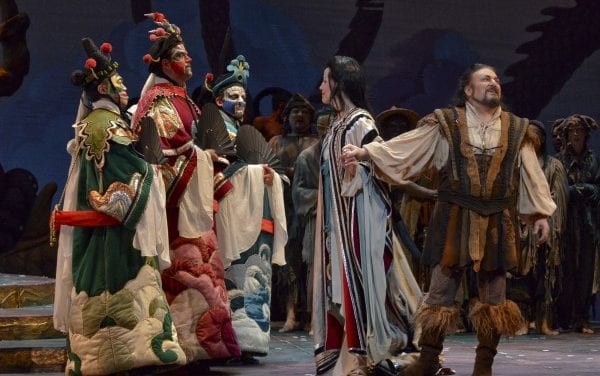
How unfair the opera world is: Turandot gets her name in the title, Calaf gets the big, famous aria, but Liu? She gets the tragic love story, the brutal ending and, at least in the Dallas Opera’s current production of Puccini’s last opera, the pipes. She’s the emotional focus, the true tragic hero, of this Turandot. Hei-Kyung Hong transforms the opera, wonderfully achieving emotional beauty in a powerful interpretation; she rips the rug right from under the others. That’s an accomplishment, since all the principals do excellent work.
Antonello Palombi as Calaf does well in Acts 1 and 2, but the disappointment is his “Nessun Dorma,” which for unfathomable reasons he sings mostly while sitting down, robbing his diaphragm of is strength. Aside from a technical glitch (a big one) in Act 1 of opening night, the production is a marvel of beauty and moody lighting, under Garnett Bruce’s direction an expert management of the chorus by Alexander Rom. This is your last weekend to see it, so get moving.
From the operatic stage to the balletic medium of film is quite a leap, but balletic is the only term to apply to Terrence Malick’s To the Wonder. By my count, only four filmmakers of the past 40 years — the late Stanley Kubrick, Jean-Jacques Annaud, David Lynch and Malick — truly qualify as cinematic artists: Directors more concerned with making visionary works that serving a commercial or even accessible audience. (A fifth, Ang Lee, is well on his way to that status as well.) These are men who make movies on their terms, inventing their own idioms and grammar. They refer almost to nothing and no one. That’s what artists get to do.